AI Etüt Oturumu

Oturum Bilgileri

Başlangıç
24 October 2025, 05:39
Bitiş
Devam ediyor
Süre
16 dakika
Durum
Devam Ediyor

AI Öğretmen Değerlendirmesi

Tespit Edilen Eksikler

Konular:
  • Operations with Exponential and Radical Representations of Real Numbers
Alt Konular:
  • Exponents
Kazanımlar:
  • Ability to reason about operations with exponential and radical representations of real numbers

Detaylı Değerlendirme

Genel Değerlendirme

Öğrenci, Exponents (Üslü Sayılar) alt konusu üzerinde karma bir performans sergilemiştir. Dersin başında konunun detaylı anlatılmasını istemesi, öğrenme konusunda istekli olduğunu göstermektedir. Ancak, temel üslü sayı kurallarını uygulamada belirgin zorluklar yaşamaktadır. Öğrenci, bazı kuralları doğru bir şekilde uygularken, diğerlerinde temel kavram yanılgıları göstermiştir.

Öğrencinin Eksik Olduğu Konular

Öğrencinin özellikle aşağıdaki alanlarda zorlandığı gözlemlenmiştir:
-
Kesirli ve Negatif Tabanlara Üs Uygulama: Sorulan ilk soruda `(-3/4)^3` ifadesini `9/12` olarak yanlış cevaplamıştır. Bu cevap, üssü hem paya hem de paydaya doğru bir şekilde uygulamadığını ve negatif tabanın tek kuvvetinin sonucunu doğru hesaplayamadığını göstermektedir. Öğrenci, üs almayı çarpma işlemiyle karıştırmış gibi görünmektedir (3*3 ve 4*3).
- Üslü Sayılarda Bölme Kuralı: `(p^9)/(p^4)` sorusuna `p^2.25` cevabını vermiştir. Bu, tabanları aynı olan üslü ifadeler bölünürken üslerin çıkarılması gerektiğini anlamadığını, bunun yerine üsleri birbirine böldüğünü (9/4) göstermektedir. Bu, yaygın bir kavram yanılgısıdır.

Öğrencinin İyi Olduğu Konular

Öğrencinin aşağıdaki alanlarda daha başarılı olduğu görülmüştür:
-
Üslü Sayılarda Çarpma Kuralı: `(5a^2b) * (2ab^3)` ifadesini `10a^3b^4` olarak doğru bir şekilde basitleştirmiştir. Bu, katsayıları doğru bir şekilde çarptığını ve aynı tabana sahip değişkenlerin üslerini doğru bir şekilde topladığını göstermektedir.
- Üssün Üssü Kuralı: Dersin sonlarına doğru sorulan ve birden fazla kuralı birleştiren (`x^10` cevabını gerektiren) soruyu doğru cevaplamıştır. Bu, üssün üssü kuralını anladığını ve diğer kurallarla birleştirebildiğini göstermektedir.

Ders Dışı Sorular/Yorumlar

Ders sırasında konu dışı herhangi bir soru veya yorum kaydedilmemiştir.
📜 Oturum Detayları

05:39:41
Öğrenci
Yes, I am ready! Can you explain this topic in detail?
05:39:42
💭 AI Öğretmen
Let me prepare that now
05:39:42
🎥 Video
05:39:43
AI Öğretmen
Did you understand how the laws of exponents apply to different types of exponents?
05:41:38
Öğrenci
I got it
05:41:39
💭 AI Öğretmen
Let us review this
05:41:40
❓ Soru basic
Evaluate $(-\frac{3}{4})^3$
05:41:58
Öğrenci
My answer is: 9 / 12
05:41:59
💭 AI Öğretmen
Let me review that answer
05:42:03
AI Öğretmen
Your answer was not correct, let me explain why. When you raise a fraction to a power, you need to apply the exponent to both the numerator and the denominator separately.
05:42:05
AI Öğretmen
In this case, the expression is \((- \frac{3}{4})^3\), which means \((- \frac{3}{4}) \times (- \frac{3}{4}) \times (- \frac{3}{4})\). You should cube both the numerator \(-3\) and the denominator \(4\).
05:42:07
AI Öğretmen
Cubing the numerator: \((-3)^3 = -3 \times -3 \times -3 = -27\). Cubing the denominator: \(4^3 = 4 \times 4 \times 4 = 64\).
05:42:09
AI Öğretmen
Therefore, the result is \(\frac{-27}{64}\). Notice the negative sign stays because the exponent is odd, so the negative base remains negative.
05:42:10
AI Öğretmen
A common mistake is to forget to cube the negative sign or to only cube the numbers without considering the negative sign or the denominator.
05:42:12
AI Öğretmen
So, the correct answer should be \(-\frac{27}{64}\), not \(\frac{9}{12}\). Keep practicing exponent rules on fractions, and you'll get even better!
05:42:12
AI Öğretmen
Should we continue with the lecture?
05:48:05
Öğrenci
Alright, let's continue
05:48:06
💭 AI Öğretmen
Proceeding to next step
05:48:12
🎥 Video
05:48:13
AI Öğretmen
Did you understand how to apply the multiplication rule for exponents?
05:49:19
Öğrenci
I got it
05:49:20
💭 AI Öğretmen
Let us review this carefully
05:49:21
❓ Soru basic
Simplify using the exponent laws: $5a^{2}b \times 2ab^{3}$
05:49:42
Öğrenci
My answer is: 10a^3b^4
05:49:43
💭 AI Öğretmen
Noted your answer
05:49:47
AI Öğretmen
Fantastic job! You absolutely nailed it!
05:49:48
AI Öğretmen
You correctly multiplied the numerical coefficients (5 and 2) to get 10.
05:49:50
AI Öğretmen
Then, you correctly applied the product of powers rule by adding the exponents for 'a' ($a^2 \times a^1 = a^3$) and for 'b' ($b^1 \times b^3 = b^4$).
05:49:50
AI Öğretmen
This shows a great understanding of how to combine terms with exponents!
05:49:51
AI Öğretmen
Therefore the correct answer is $10a^3b^4$.
05:49:51
AI Öğretmen
Should we continue with the lecture?
05:50:21
Öğrenci
Alright, let's continue
05:50:22
💭 AI Öğretmen
Proceeding to next example
05:50:29
🎥 Video
05:50:29
AI Öğretmen
Did you understand how to apply the division rule for exponents with and without coefficients?
05:50:55
Öğrenci
I got it
05:50:57
💭 AI Öğretmen
Let us review this carefully
05:50:57
❓ Soru basic
Simplify using the exponent laws: $(p^9) / (p^4)$
05:51:19
Öğrenci
My answer is: p^2.25
05:51:20
💭 AI Öğretmen
Let me review that closely
05:51:25
AI Öğretmen
Your answer was not correct, let me explain why. When dividing powers with the same base, you do not divide the exponents; instead, you subtract the exponent in the denominator from the exponent in the numerator.
05:51:27
AI Öğretmen
Here, the expression is \(\frac{p^9}{p^4}\). According to the quotient rule of exponents, \(\frac{a^m}{a^n} = a^{m-n}\). So, you subtract 4 from 9, which gives you \(p^{9-4} = p^5\).
05:51:29
AI Öğretmen
A common misconception is to divide the exponents (like 9 ÷ 4 = 2.25), but this is not how exponent laws work when dividing powers with the same base. Instead, always subtract the exponents in this case.
05:51:31
AI Öğretmen
For example, \(\frac{x^7}{x^3} = x^{7-3} = x^4\), not \(x^{7/3}\). This helps keep the rules consistent and simplifies expressions correctly.
05:51:32
AI Öğretmen
Therefore, the correct answer should be \(p^5\). Keep practicing these rules, and you'll get more comfortable with exponent laws!
05:51:32
AI Öğretmen
Should we continue with the lecture?
05:52:36
Öğrenci
Alright, let's continue
05:52:37
💭 AI Öğretmen
Preparing the next part
05:52:43
🎥 Video
05:52:43
AI Öğretmen
Did you understand how to apply the power of a power rule?
05:54:09
Öğrenci
I got it
05:54:11
💭 AI Öğretmen
Let's reinforce this now
05:54:11
❓ Soru medium
Simplify the following algebraic expression completely. Write your final answer using a single base and a positive exponent. $$ \frac{((x^{-2})^3 \cdot (x^5)^{-1})^{-2}}{(x^3)^4} $$
05:54:43
Öğrenci
My answer is: x^10
05:54:44
💭 AI Öğretmen
Let me review your solution
05:54:51
AI Öğretmen
Fantastic job! You've correctly simplified the expression to x^10!
05:54:52
AI Öğretmen
You expertly applied the power of a power rule by multiplying the exponents and then combined terms with the same base by adding or subtracting their exponents.
05:54:53
AI Öğretmen
This shows a great understanding of how to handle negative exponents and quotients of powers. Keep up the excellent work!
05:54:54
AI Öğretmen
Therefore the correct answer is x^10.
05:54:54
AI Öğretmen
Should we continue with the lecture?
05:55:20
Öğrenci
Alright, let's continue
05:55:20
💭 AI Öğretmen
Moving to next concept
05:55:27
Görsel
Görsel
05:55:29
AI Öğretmen
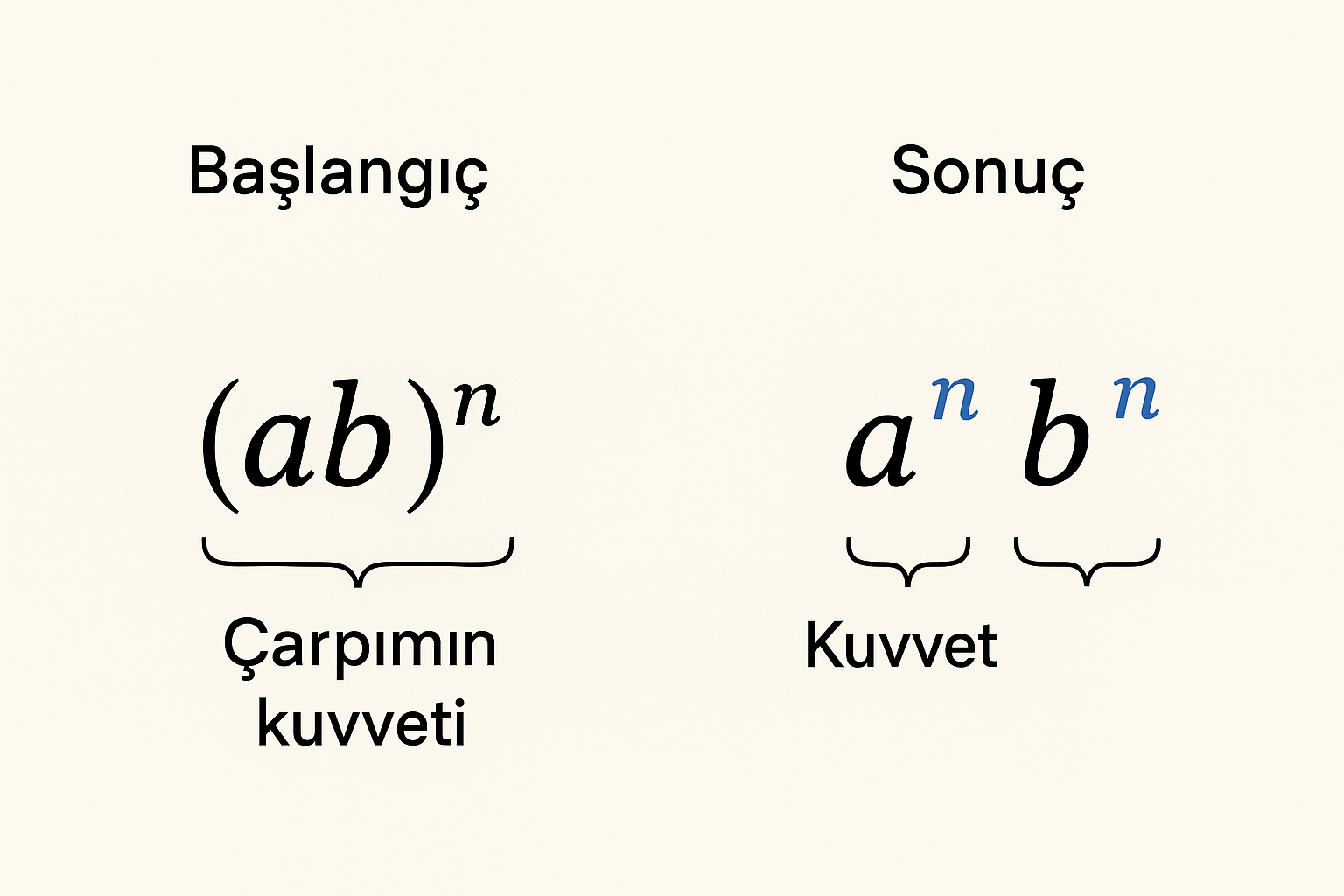
The power of a product rule helps when you have a group of numbers or variables multiplied together, and all of them are inside parentheses with an exponent outside.
05:55:30
AI Öğretmen
This rule says that every factor inside the parentheses needs to get that exponent.
05:55:32
AI Öğretmen
You can write this rule as $(ab)^n = a^n b^n$. Here, $a$ and $b$ are any numbers, and $n$ is how many times you multiply the group by itself.
05:55:34
AI Öğretmen
Let's look at the example $(4w)^3$. That means you do $4 \times w$ three times: $(4w) \times (4w) \times (4w)$. According to the rule, this is the same as $4^3 \times w^3$.
05:55:36
AI Öğretmen
$4^3$ means $4 \times 4 \times 4$ which is $64$, and $w^3$ means $w \times w \times w$. So the answer is $64w^3$.
05:55:38
AI Öğretmen
Another example is $(5x^2)^3$. This means $5$ times $x^2$, all to the third power. You do $5^3$ which is $125$, and $(x^2)^3$ which is $x^{2\times 3} = x^6$. So the answer is $125x^6$.
05:55:40
AI Öğretmen
Now, look at $(3m^2n^3)^4$. You give the $3$, $m^2$, and $n^3$ all the power of $4$.
05:55:42
AI Öğretmen
$3^4$ is $81$, $(m^2)^4$ is $m^{2\times4} = m^8$, and $(n^3)^4$ is $n^{3\times4} = n^{12}$.
05:55:45
AI Öğretmen
So, $(3m^2n^3)^4$ becomes $81m^8n^{12}$. The same example is written two times to help you see the steps.
05:55:47
AI Öğretmen
This rule makes it much easier to work with expressions raised to a power, because you can just give the exponent to each part inside the parentheses.
05:55:48
AI Öğretmen
Did you understand how the power of a product rule works?